
More Than a Deep Breath: A Practical Look at Breathwork

You’re at the kitchen counter waiting for the water to boil, staring blankly at the wall, maybe drawing in a slightly deeper breath than usual. For the rest of the day, your body handles breathing quietly in the background, alongside your heartbeat and digestion. We never have to think about it.
Turning something so effortless into a structured routine feels a bit like exaggeration. If we've been doing this since birth, why practise it on purpose? Is there something real here, or are we complicating something that works perfectly well on its own?
What is “breathwork”?
Breathwork is the deliberate practice of controlling how you breathe. Much like training a specific muscle for strength, you can shape the depth, pace, and pattern of your breath to suit what your body needs at the moment. Today it often appears alongside meditation, running, yoga, Pilates, martial arts, and stands on its own within Ayurveda, traditional Chinese medicine, and contemporary alternative health.
You've felt the shifts without naming them. Breathing quickens during exercise or a rush of excitement, just as you’ve heard the slow, steady rhythm of someone drifting off to sleep. It’s one of the few bodily functions that is both automatic and voluntary. Beyond delivering oxygen, it reflects emotion, signals stress, and occasionally precedes serious events like a heart attack. Paying attention to it may be one of the quietest but most useful forms of self-care.
A deep breath won’t flood your blood with oxygen
Breathing regulates the balance of oxygen and carbon dioxide in the blood. We tend to assume a big inhale delivers noticeably more oxygen, but for healthy people at sea level, blood oxygen is already near its ceiling because haemoglobin is close to fully saturated. The calm that follows a deep breath isn’t really about extra oxygen. It comes from shifts in rhythm, carbon dioxide levels, and the way breathing interacts with the autonomic nervous system (ANS).
Credit: Pinterest
When you’re about to speak in public, your sympathetic nervous system (SNS) kicks in. Your heart races, your breathing becomes quick and shallow. Slowing the breath usually helps. But breathing too fast or too deeply for what your body actually needs tips you into hyperventilation.
Hyperventilating expels too much carbon dioxide, which alters blood chemistry and makes haemoglobin cling to oxygen more tightly, leaving less available to the tissues [1]. So you feel dizziness, tingling around the hands or mouth, light-headedness, and that unsettling sense of being unable to catch your breath [1]. Breathing into a paper bag was once the go-to fix because it raises inhaled carbon dioxide, but it's no longer advised outside medical settings, as similar symptoms can point to something more serious, particularly for those with respiratory or cardiovascular conditions [2].
The only automatic function you can consciously steer
The ANS quietly manages heart rate, blood pressure, digestion, and breathing, adjusting constantly behind the scenes. Its two branches, the sympathetic and parasympathetic nervous systems (PNS), work together to help the body respond to changing situations [3]. The sympathetic division prepares you for action, such as before public speaking or during exercise; the parasympathetic restores you to a resting state once the challenge has passed [3].
Unlike other automatic functions, breathing can be consciously adjusted. By changing its rhythm and depth, we can indirectly influence the ANS and, in turn, other physiological responses to stress.

Credit: Pinterest
Heart rate is a good example. When you breathe in, your heart rate speeds up slightly; when you breathe out, it slows down. This variation contributes to what’s known as heart rate variability (HRV). If you wear a smartwatch or fitness tracker, you've probably seen the acronym reported alongside your resting heart rate or sleep score. When breathing slows, each inhalation and exhalation lasts longer, making these natural fluctuations more pronounced. As a result, HRV often rises during slow, controlled breathing.
HRV varies significantly between individuals and should be interpreted relative to your own baseline. There is no universal "healthy" HRV, but a higher HRV within an individual is generally associated with greater autonomic flexibility and a better ability to adapt to physical and psychological stress.
The way we live changes how we breathe
Smoking is often the first factor people associate with poor breathing, but plenty of everyday habits shape it too, making our breath faster, shallower, or less efficient.
Long hours of sitting don't just reduce your movement. They restrict the very muscles that power your breath. The diaphragm and rib cage stay relatively inactive, limiting chest expansion and encouraging shallow chest breathing rather than diaphragmatic breathing. Several studies have found that prolonged sedentary behaviour is associated with breathlessness, with symptoms becoming more common as activity decreases [4] [5].

Credit: Pinterest
Poor posture can make this even worse. Forward head posture, rounded shoulders, or a hunched back limit rib cage movement and reduce the space available for the lungs to expand. These postural changes are linked to reduced lung function, lower inspiratory muscle strength, and decreased breathing efficiency [6]. Obesity and being overweight also mechanically crowd the diaphragm and chest wall, making breathing more effortful [7].
Chronic stress affects differently. Under stress, the SNS becomes more active, and breathing turns faster and shallower [8]. Over time, this pattern can become habitual, even after the stressor has passed. Stress also tightens the muscles around the neck, shoulders, and chest, so breathing feels harder. For people with asthma, psychological stress has been associated with more frequent flare-ups and greater airway inflammation, creating a loop between stress and respiratory symptoms [9].
Another commonly overlooked factor is mouth breathing. Unlike the mouth, the nose warms, humidifies, and filters incoming air, and produces nitric oxide, a molecule that helps regulate blood flow and improves oxygen exchange in the lungs. Chronic nasal obstruction, such as allergic rhinitis or a deviated septum, often pushes people towards mouth breathing, which has been linked to poorer sleep quality, dry mouth, and daytime fatigue [10]. In children, it may also influence facial and jaw development if left untreated [10].
What breathwork can genuinely help with?
The strongest evidence sits in mental wellbeing. Studies consistently show that breathing exercises reduce perceived stress and improve mood [11]. Neuroimaging has picked up changes in brain regions involved in emotional regulation after breathing practice [12]. In one study, breathwork produced greater improvements in mood and stress response than mindfulness meditation [13].
Breathwork has also been investigated as a complementary strategy for pain. Healthy volunteers exposed to experimental heat pain and patients with chronic pain both reported lower pain unpleasantness following breathing exercises [14] [15].

Credit: Pinterest
Slow, paced breathing has been associated with improved sleep quality too. In patients with obstructive sleep apnoea, daytime breathing exercises reduced fatigue and excessive daytime sleepiness [16].
There’s also evidence for breathing exercises as a complement to prescribed medication or lifestyle interventions for lowering blood pressure. Inspiratory muscle strength training (IMST), which involves 30 forceful inhalations over roughly five minutes, is a notable example. A 2021 study by Craighead and colleagues reported clinically meaningful reductions in blood pressure following daily IMST, with effects comparable to or greater than those typically seen after much longer aerobic exercise programmes [17].
What remains uncertain?
Research is expanding into many other areas, but the evidence is still limited. One frequently discussed example is immune function. A study found that participants trained in breathing exercises together with cold exposure showed lower inflammatory responses during an experimental immune challenge, and breathing practice alone altered several inflammatory cytokines [18]. Another trial reported reductions in cortisol and IgA levels after three weeks of breathing exercises in women with breast cancer [19]. While these findings are encouraging, they remain preliminary, small, and short-term, which should not be interpreted as evidence that breathwork "boosts immunity."
And what breathwork cannot do
Some popular claims aren’t supported by the evidence. Breathwork doesn’t “detoxify the body”, substantially increase blood oxygen in healthy individuals, activate the pineal gland, erase traumatic memories, or cure chronic diseases. It's best understood as a tool for regulating your physiological and psychological response to stress, not a cure-all.
Choosing the right practice for you [20]
If you’re looking to relax, slow breathing is the easiest place to begin. It requires no specific environment and only a few repeated cycles to feel a shift. Diaphragmatic breathing (belly breathing), paced breathing, and 4-7-8 breathing all focus on the body and the length of each inhale and exhale. They slow the overall rate and prolong exhalation, making them ideal for winding down or during stressful moments.
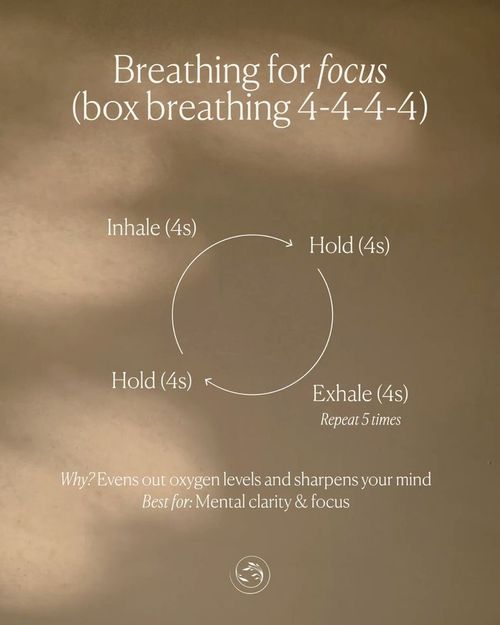
To regain focus, try box breathing, which you may recognise from yoga. It divides the breath into four parts, like a box: four counts in, four holding, four out, four holding again. That simple rhythm is why it’s popular with athletes, military personnel, and people managing acute stress.
Credit: Pinterest
Alternate nostril breathing, or channel-clearing breath, is a traditional yoga technique that involves breathing through one nostril at a time. Studies suggest potential benefits for stress reduction, though traditional explanations, such as balancing the two brain hemispheres, remain unsupported [21].
Stimulating breathing, including holotropic breathwork, conscious connected breathing, the Wim Hof method, and Breath of Fire, deliberately increases breathing intensity and can cause temporary reductions in blood carbon dioxide, leading to dizziness, tingling, or altered sensations. These aren't for everyone and are best practised with proper instruction.
Credit: Pinterest
Breathwork is generally safe, but not every technique suits everyone. Avoid intense breathing exercises in the bath or in water, while driving, or at heights. If you have panic disorder, epilepsy, cardiovascular disease, asthma, or you’re pregnant, it’s better to speak to your practitioner before starting.
Like exercise, breathwork works best with consistent rather than occasional attempts. If you're new to it, start with just a few minutes of slow breathing each day before moving on to more advanced techniques.
And we're about to add guided and unguided breathwork sessions to the app that you can "play" and listen along to while doing them. Start here.
This article is for informational purposes only and does not constitute medical advice. Consult a healthcare provider before making changes to your health routine.
Common Question
There’s a popular idea that carbon dioxide is beneficial because it helps haemoglobin release oxygen to the tissues. Does this mean breathwork practices that deliberately induce short periods of hyperventilation could be harmful?
Not really. A short, controlled period of hyperventilation as part of a breathwork practice is quite different from uncontrolled or persistent hyperventilation. It’s usually brief and can be brought back to normal breathing fairly easily, so symptoms may be mild or not appear at all.
Deliberate hyperventilation does lower carbon dioxide, and this can temporarily change how tightly haemoglobin holds onto oxygen and reduce oxygen unloading to the tissues. But hyperventilation outside of breathwork is often driven by anxiety, pain or an underlying condition, and may continue until the cause is addressed or intervention is needed to restore normal breathing.
Want to dive deeper and explore more articles? Download the Lifestack app to unlock the full experience: