

Your brain doesn’t clock off. On the morning commute, you register the new billboards on the platform. By midday, you’ve picked up on a subtle shift in the office. At the shop after work, you're weighing whether the fat-free yoghurt really counts as a healthy snack. The mind processes the external world without pause. But what about our inner world? Beneath all that noise sits how we actually feel: about our lives, about ourselves. It gets buried, and we end up confused, overwhelmed, and quietly worn down. Meditation is one of the oldest answers to this problem, an invitation to turn attention inward. But does it actually work, and is it really the route to some sort of inner calm?
What meditation actually is
Meditation, sometimes called
mindfulness
or
reflection
, is a practice that connects the internal (mind) with the external (body and surroundings) to train attention and awareness. Its earliest forms were tied to spiritual and religious traditions, meant to deepen understanding of the sacred. Today, stripped of that framing, it’s more often used simply to steady the mind and emotions, with the added benefit of supporting physical health.
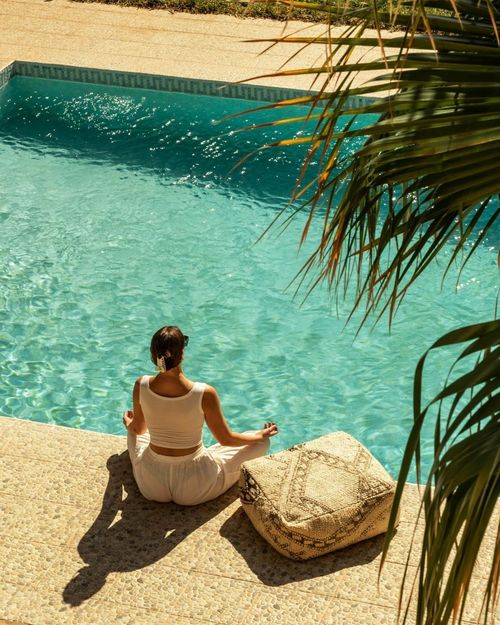
Image: Meditation Credit: Pinterest You can practice through concentration alone, or lean on tools like music, guided narrative, prayer beads, or mantra to help you settle into a state of flow more quickly. What happens when you close your eyes?
Meditation and the brain
Meditation appears to influence brain regions involved in emotion and thinking.
The frontal areas, particularly the medial regions tied to emotion regulation and decision-making, are consistently engaged during practice [1]. So are the cortical midline structures, which govern self-awareness and self-reflection [1]. Neuroimaging has also picked up changes in the hippocampus and thalamus, linked to memory and sensory processing [1].
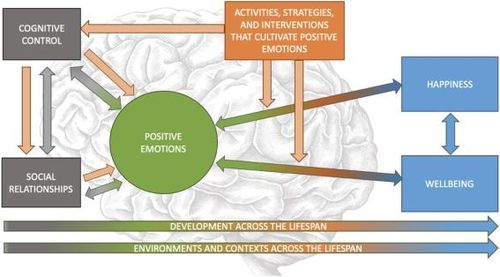
Figure: A Conceptual Model of the Psychological Correlates of Positive Emotions that Influence Happiness and Wellbeing Outcomes. Credit: The neuroscience of positive emotions and affect: Implications for cultivating happiness and wellbeing Meditation also seems to
strengthen communication between brain networks
. The brain shifts between different networks depending on what you’re doing. The Default Mode Network (DMN) takes over when you’re resting or daydreaming; the Salience Network (SN) snaps to attention when someone calls your name, or a strange sound cuts through. Whether meditation increases or decreases the connectivity within these networks is still debated, but the reorganisation itself is consistently observed [2]. The variation likely comes down to differences in practice duration, participant demographics, and how studies are analysed. Meditation shares some physiology with breathwork, shifting the
autonomic nervous system
. One of the clearest markers is increased heart rate variability, with more experienced practitioners showing more coherent heart rhythms [3]. It also helps re-regulate the HPA axis, lowering cortisol [4]. Five RCTs found a larger effect with longer training, suggesting the body learns to respond to stress more efficiently and recover more quickly [5].

Image: Singing bowls Credit: Pinterest With consistent practice, these functional shifts can become more lasting through
neuroplasticity
. The brain's capacity to reorganise itself in response to experience. Meditation has been linked to increased production of brain-derived neurotrophic factor (BDNF), a protein that supports neuron growth, strengthens synaptic connections, and promotes learning and memory [6]. Over time, these adaptations reinforce the improvements in emotional regulation, attention, stress resilience, and network communication seen in long-term practitioners [6]. What can meditation do?
The evidence for mental wellbeing
The evidence for
mental wellbeing
is solid. A systematic review and meta-analysis found that 8-week meditation programmes reduce symptoms of anxiety and depression, with modest improvements in stress and mental health-related quality of life [7]. And these benefits aren’t reserved for the seasoned. Beginners practicing just 13 minutes a day over 8 weeks also showed measurable improvements in mood [8].

Image: Beach Yoga Credit: Pinterest Meditation also seems to
change how the brain handles emotional stress
[9]. When participants anticipated seeing negative images, activity increased in the prefrontal cortex, the region involved in emotional regulation. When they actually saw the images, activity in emotion-processing regions dropped. These changes suggest that the brain learns to regulate negative emotion with less effort. Pain management is another area where the results hold up. A 10-week meditation programme has been shown to reduce pain-related distress, negative thoughts about the body, and limitations in daily activities caused by pain. Compared with painkillers alone, meditation offered additional benefits, many of which lasted up to 15 months after training [10]. Even short practices seem to shift how the brain processes pain: four 20-minute sessions altered activity in the regions that manage the emotional and cognitive dimensions of it [11]. What meditation may help with?
Meditation, cognition and ageing
Meditation may also support cognitive function, including attention and memory
, with benefits observed in older adults and people experiencing cognitive difficulties or mood disorders [8] [12] [13] [14]. For this reason, it’s being explored as a tool for healthy aging and reducing the risk of cognitive decline. One study found that Kirtan Kriya, a specific meditation practice, increased telomerase activity by 43% [15]. Telomerase helps maintain telomeres, which are involved in cellular ageing, making this one of the largest increases reported in a meditation study at the time of publication. Meditation may also influence immune health more broadly.
An analysis of 1,602 participants who practiced meditation found lower levels of inflammatory markers, including NF-κB and C-reactive protein [16]. Smaller studies with shorter follow-up have also found that mind-body practices may enhance the immune response to vaccination [17] [18]. Mantra meditation, in which people repeat encouraging or affirming phrases, has been linked to immune benefits as well [18] [19]. Promising signals, though the clinical scale of these effects still needs more research. There’s also emerging evidence for chronic conditions like diabetes and hypertension.
Regular meditation may help lower blood pressure and improve markers such as HbA1c and inflammatory activity [20] [21], likely tied to better stress regulation, since chronic stress feeds both conditions. Find your way in [22]
Is meditation safe for everyone?
For most people, meditation is low-risk, and those dealing with stress or unease often find real benefits
. But if you’re managing
PTSD, bipolar disorder, severe anxiety, dissociative disorder, suicidal thoughts, or substance use
, consult a practitioner first and work with a professional rather than practicing alone. Adverse effects such as anxiety, low mood, or cognitive disturbances have been reported, occasionally even in people with no prior diagnosis [23]. Start with three to five minutes of guided meditation, which gently eases you into the practice. From there, you’ll find the approach that suits you. Common Questions
My mind wanders constantly, I don’t think meditation is for me
That’s part of it
That’s part of it. Noticing you’ve drifted actually means you’re paying attention to your mind, which is the whole point.
Don’t judge it. Just return to the practice.
Research shows that mind wandering, becoming aware of it, shifting your attention, and sustaining focus each activate different parts of the brain, and cycling through them is precisely how the mind gets trained [24]. Even long-time meditators still wander. Catching yourself and coming back is the work, and it’s what strengthens attention and awareness over time.
Guided, silent, movement… which type is right for me?
Image: Wellness Retreats Credit: Pinterest
Guided meditation
Guided meditation walks you through a focus point, whether imagery, body sensations, thoughts, breath, or repeated words. It’s beginner-friendly because each session has a fixed length and you simply follow the voice.
- Unguided meditation
- is done alone, at your own pace. It asks for more experience, since beginners often lose the thread or feel unsure of what they’re meant to be doing.
- Assisting tools like singing bowls or prayer beads
- create an anchor through sound or touch, offering steadier attention and a sense of ritual.
- Movement-based practices such as Tai chi and yoga
- combine slow movement, breath regulation, and present-moment awareness. If sitting still feels impossible, these are a natural alternative.
Is meditation safe for everyone?
For most people, meditation is low-risk, and those dealing with stress or unease often find real benefits.
But if you’re managing PTSD, bipolar disorder, severe anxiety, dissociative disorder, suicidal thoughts, or substance use, consult a practitioner first and work with a professional rather than practicing alone. Adverse effects such as anxiety, low mood, or cognitive disturbances have been reported, occasionally even in people with no prior diagnosis [23]. Start with three to five minutes of guided meditation, which gently eases you into the practice. From there, you’ll find the approach that suits you.
Common Questions
My mind wanders constantly, I don’t think meditation is for me
That’s part of it. Noticing you’ve drifted actually means you’re paying attention to your mind, which is the whole point. Don’t judge it. Just return to the practice. Research shows that mind wandering, becoming aware of it, shifting your attention, and sustaining focus each activate different parts of the brain, and cycling through them is precisely how the mind gets trained [24]. Even long-time meditators still wander. Catching yourself and coming back is the work, and it’s what strengthens attention and awareness over time.
Guided, silent, movement… which type is right for me?
Guided meditation walks you through a focus point, whether imagery, body sensations, thoughts, breath, or repeated words. It’s beginner-friendly because each session has a fixed length and you simply follow the voice. Unguided meditation is done alone, at your own pace. It asks for more experience, since beginners often lose the thread or feel unsure of what they’re meant to be doing. Assisting tools like singing bowls or prayer beads create an anchor through sound or touch, offering steadier attention and a sense of ritual. Movement-based practices such as Tai chi and yoga combine slow movement, breath regulation, and present-moment awareness. If sitting still feels impossible, these are a natural alternative.