
Multi-Nutrients for the Modern Mind

Another look at multi-vitamin and multi-mineral supplements.
Most of us have been taught the same model, and most medical providers are trained in it too: test the blood, find what's missing, replace it in as absorbable a form as possible. It's a sensible approach, and it comes from somewhere specific. The earliest vitamin science was built entirely on deficiency: scurvy (vitamin C), rickets (vitamin D, calcium, phosphate), beriberi (vitamin B1), each traced back to a missing compound and each resolved by adding it back (1).
I've lived that model firsthand. Years of fatigue and fainting took multiple specialists and several rounds of blood tests to even partly explain. Along the way, I was put on liquid iron, B12 patches, and told to add more vitamin C to help the iron absorb. For a while it seemed to work, except my blood levels kept fluctuating in a way that never quite matched how tired I actually felt. It took three years before a doctor added liquid colloidal copper, and that's when things started to shift. Iron, it turns out, cannot be metabolised without copper, vitamin B12 and vitamin C working alongside it (2).
Beyond a diagnosed deficiency, there are other moments where supplementation is advised. The NHS recommends it at particular life stages: more folate during pregnancy and breastfeeding, vitamin D through the UK's darker autumn and winter months (3), and closer attention for anyone following a vegan or otherwise restrictive diet (4), or whose eating pattern doesn't consistently reflect a balanced one.
The intention, of course, is always to get these nutrients from food, since the body cannot manufacture most of them itself, but that's become a harder ask than it once was, with higher stress, less nutrient-dense soil (and produce) due to mono-cropping and pesticide use, and the proliferation of ultra-processed foods.
No effect, or no way to see it?
The reference intakes used today were established in 1991, capturing a historical baseline of basic physical necessity rather than optimal health (5). Fittingly, the biggest multivitamin trials since then have focused on physical health outcomes: cardiovascular disease (CVD), cancer, mortality. Most found no effect, no significant effect, or simply insufficient evidence either way (6, 7). What's easy to miss is that cancer, CVD and death are, thankfully, uncommon in a healthy population, which means a trial needs a very large effect, a very large sample, or a very long follow-up to detect anything at all. Multivitamin studies are notoriously difficult to power for these outcomes, so an unremarkable result may say more about the study than about the supplement.
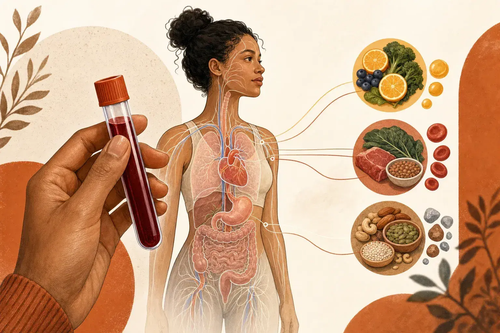
There's a second problem underneath the statistical one. Standard blood tests don't reliably predict who will respond to supplementation, something the clinical literature has echoed directly: your blood can look low without your body actually being short of what it needs (8). Testing tells you something, but it is only a proxy for what your body can genuinely use. My fluctuating iron blood levels despite continued symptoms is an illustration of this gap.
Not surviving, optimising
Life now asks something different of us: constant connectivity, demanding jobs, and rising rates of anxiety, depression and PTSD. Our needs have changed. If cognitive resilience is the goal, intakes calibrated to prevent rickets and scurvy may simply not be enough for the modern mind.
It is in resilience research that multivitamins and multiminerals have their strongest evidence. It's part of why multivitamins and multiminerals are becoming harder to dismiss outright when it comes to mental resilience and stress. A 12-week randomised trial of older adults in the UK found multivitamin supplementation reduced stress reactivity and loneliness in men and lifted mood in women, though it had no effect on the study's primary measure of overall wellbeing (9). That's not an isolated finding either: a meta-analysis pooling eight such trials found the same pattern held more broadly, with multivitamin supplementation meaningfully reducing perceived stress, mild psychiatric symptoms and anxiety in otherwise healthy adults, particularly with higher-dose B vitamin formulas (10). Professor Julia Rucklidge, one of the leading researchers in the field, has spent over a decade building the evidence on multinutrients and psychiatric symptoms. After the 2011 Christchurch earthquake, her team at the University of Canterbury gave broad-spectrum micronutrients to adults struggling with acute anxiety and stress, and watched the proportion meeting the threshold for probable PTSD fall from 65% to 19% within a month, an effect that held a year later (11, 12). The team later found the same broad-spectrum approach reduced irritability and anger, though not stress overall, in university students during the COVID-19 pandemic (13), and more recently extended the work to children, finding a related effect on emotional regulation (14).

A few considerations follow naturally from this…
Nutrients rarely act alone
During metabolic processes, many vitamins and minerals function as co-factors, interacting in genuinely complex ways, iron, copper, B12 and vitamin C among them (2). Take too much zinc on its own, for instance, and you'll deplete your copper, simply because the two run through the same metabolic pathways.
How much is too much?
Recommended intakes tend to sit well below the upper limit, often by a wide margin, and bioavailability, how much of a given nutrient the body actually absorbs and uses, varies enormously by nutrient and by form (15). Many supplements barely reach the recommended amount in the first place, and even then, you only end up using a fraction of what's on the label. It's worth looking for broad-spectrum, reasonably high-dose formulas covering both vitamins and minerals, rather than a narrow handful of the most talked-about ones.
Know before you buy
In the UK, supplements are regulated as food, not medicine. The Food Standards Agency requires accurate nutrition information and legitimate health claims (17). Less well known is that supplements aren't required to be independently tested before they reach a shelf, which makes it worth checking whether a product's ingredients have been third-party tested.
Be your own researcher
If you've tried a multivitamin before and felt nothing, it's worth asking which of the points above actually caught you out, a narrow formula missing half the relevant co-factors, a cheap one using poorly absorbed forms, or simply not taking it consistently enough to know either way. If you're already taking a multivitamin, or thinking about starting one, the more useful question is whether you notice any change, in mood, energy or otherwise. That feeling is the signal worth relying on.
None of this is a reason to dismiss the published research, it's genuinely useful, and it's what this article has drawn on throughout. However, population studies describe averages, and no study was ever designed around your particular body, your stress levels, your absorption. A label or a certification tells you what should be true in general. Your own response, tracked honestly over time, tells you what's actually true for you. Lifestack is built to help with exactly that, keeping the record, so your own body becomes part of the evidence you rely on.

Author: Ms Kaeleigh Elliott, MPH Epidemiology & Biostatistics
This article is for general information and does not constitute medical advice. Always speak with a qualified healthcare professional before starting any new supplement, particularly if you are pregnant, managing a health condition, or taking other medication.
References
Funk Casimir. The Etiology of The Deficiency Diseases. The Journal of State Medicine. 1912; 20:341-368.
Bost M, Houdart S, Oberli M, Kalonji E, Huneau JF, Margaritis I. Dietary copper and human health: current evidence and unresolved issues. J Trace Elem Med Biol. 2016; 35:107-115. doi: 10.1016/j.jtemb.2016.02.006.
National Health Service (NHS). Vitamins and minerals [Internet]. London: NHS; 2020 Aug 3 [cited 2026 Sep 1]. Available from: https://www.nhs.uk/conditions/vitamins-and-minerals/
National Health Service (NHS). The vegan diet [Internet]. London: NHS; 2026 Jun 5 [cited 2026 Sep 1]. Available from: https://www.nhs.uk/live-well/eat-well/how-to-eat-a-balanced-diet/the-vegan-diet/.
Committee on Medical Aspects of Food Policy. Dietary reference values for food energy and nutrients for the United Kingdom. London: HMSO; 1991.
National Institutes of Health, Office of Dietary Supplements. Multivitamin/mineral supplements: fact sheet for health professionals [Internet]. Bethesda (MD): NIH; 2024 Jul 17 [cited 2026 Aug 28]. Available from: https://ods.od.nih.gov/factsheets/MVMS-HealthProfessional/
US Preventive Services Task Force. Vitamin, Mineral, and Multivitamin Supplementation to Prevent Cardiovascular Disease and Cancer. JAMA. 2022;327(23):2326–2333. doi:10.1001/jama.2022.8970
Shenkin A, Berger MM. Micronutrients: A low blood concentration is not equivalent to deficiency. Clin Nutr. 2022 Nov;41(11):2562-2564. doi: 10.1016/j.clnu.2022.09.015. Epub 2022 Oct 1. PMID: 36228568.
Docherty S, Wetherell MA, McInnes L, Haskell-Ramsay CF. Improvements to mood, stress and loneliness following 12-week multivitamin supplementation in older adults: a randomised, placebo-controlled, trial. Eur J Clin Nutr. 2025 Mar;79(2):126-135. doi: 10.1038/s41430-024-01517-6.
Long SJ, Benton D. Effects of vitamin and mineral supplementation on stress, mild psychiatric symptoms, and mood in nonclinical samples: a meta-analysis. Psychosom Med. 2013 Feb;75(2):144-53. doi: 10.1097/PSY.0b013e31827d5fbd.
Rucklidge JJ, Andridge R, Gorman B, Blampied N, Gordon H, Boggis A. Shaken but unstirred? Effects of micronutrients on stress and trauma after an earthquake: RCT evidence comparing formulas and doses. Hum Psychopharmacol. 2012 Sep;27(5):440-54. doi: 10.1002/hup.2246. Epub 2012 Jul 11. PMID: 22782571.
Rucklidge JJ, Blampied N, Gorman B, Gordon HA, Sole E. Psychological functioning 1 year after a brief intervention using micronutrients to treat stress and anxiety related to the 2011 Christchurch earthquakes: a naturalistic follow-up. Hum Psychopharmacol. 2014 May;29(3):230-43. doi: 10.1002/hup.2392.
Katta NM, Blampied NM, Mulder RT, Rucklidge JJ. Micronutrients absorbed via the oral mucosa reduce irritability and anger but not stress in university students during COVID-19: a randomized placebo-controlled trial. Int J Stress Manag. 2023. https://doi.org/10.1037/str0000291
Katta NM, Blampied NM, Eggleston M, Rucklidge JJ. Micronutrients absorbed via the oral mucosa reduce emotion dysregulation in 5-10-year-old children: A three-phased randomized wait-list-controlled trial. PLoS One. 2024 Dec 5;19(12):e0311794. doi: 10.1371/journal.pone.0311794.
Richards JD, Cori H, Rahn M, Finn K, Bárcena J, Kanellopoulos AK, Péter S, Spooren A. Micronutrient bioavailability: concepts, influencing factors, and strategies for improvement. Front Nutr. 2025 Nov 19;12:1646750. doi: 10.3389/fnut.2025.1646750.
Food Standards Agency. Food supplements guidance [Internet]. London: GOV.UK; 2026 Jun 25 [cited 2026 Aug 29]. Available from: https://www.gov.uk/government/publications/food-supplements-guidance
Want to dive deeper and explore more articles? Download the Lifestack app to unlock the full experience: