

What is grounding?
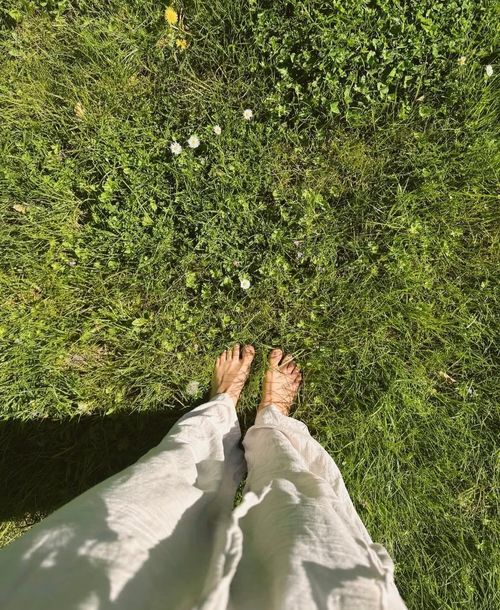
When was the last time you touched the ground? Maybe it was on a beach, walking through the grass, or standing barefoot in the garden while watching your dog run around. For most of us, direct contact with nature has become unusual. We spend much of our time in shoes, inside buildings where wooden, concrete, or carpeted floors keep our feet separated from the Earth.
But why bother going back to something our ancestors did naturally? Does making skin-to-earth contact really have any effect on our body or mind? If something as ordinary as standing barefoot on grass can affect our health, what exactly is happening when we do it?
Grounding: the basics
Grounding, also called earthing, is a practice of making direct physical contact with the Earth’s surface, barefoot on grass or soil, skin in natural water, or through conductive materials that replicate the same electrical connection indoors.

The Earth’s subtle electrical charge
The Earth carries a mild negative electrical charge, maintained by the global atmospheric electrical circuit and continuously replenished by lightning activity around the planet. This gives the Earth’s surface a virtually limitless supply of free electrons. When your bare skin makes contact with a conductive surface, those electrons can transfer into the body.
Long before it had a name, the principle appeared in traditional wisdoms, including
Qi in Traditional Chinese Medicine
, and
the broader spiritual understanding of the Earth as a restorative, cleansing force
.
German naturopath Adolf Just
advocated walking barefoot and sleeping on the ground, as a way to “draw vital strength and energy out of the Earth” in his book, Return to Nature [1]. His work inspired early naturopathic movements in the United States. By the 1920s,
American physician Dr. George Starr White
was reporting that patients slept better when their bodies were electrically connected to the Earth via copper wires [2].
Modern research on grounding
The concept fell out of mainstream conversation for most of the 20th century. Now, with a growing body of research and a cultural shift toward more intentional, nature-connected living, it is finding its way back.
Most grounding studies have been conducted indoors, using conductive mats, mattresses, or adhesive electrode patches to simulate the electrical connection of being barefoot outside. The findings are promising, though it is worth being clear that the research is still early-stage, with many studies involving small sample sizes and short follow-up periods.
Grounding may support
sleep and relaxation
. In people experiencing pain and disrupted sleep, sleeping on a conductive mattress for eight weeks was associated with a more normal daily cortisol pattern and reduced stress levels [10]. One hour of grounding was linked to a more positive mood and a greater sense of ease [11]. When grounding was combined with a relaxation practice such as meditation, participants reported feeling more deeply relaxed and focused [12].
Grounding may also have potential in managing
inflammation and recovery
. In a study on delayed-onset muscle soreness, the stiffness and discomfort that follows intense or unfamiliar exercise, grounded participants showed differences in immune cell activity, blood markers, and both perceived and measured pain compared to the non-grounded group [13]. Separately, grounding appeared to accelerate the healing of open wounds and reduce visible signs of injury including redness, heat, swelling, and pain [3].
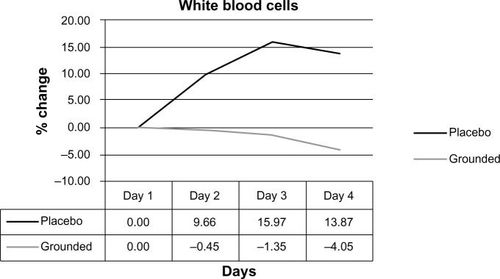
Figure: Comparisons of white blood cell counts, comparing pretest versus post-test for each group.
Credit: The effects of grounding (earthing) on inflammation, the immune response, wound healing, and prevention and treatment of chronic inflammatory and autoimmune diseases
There is also some preliminary evidence for
metabolic effects
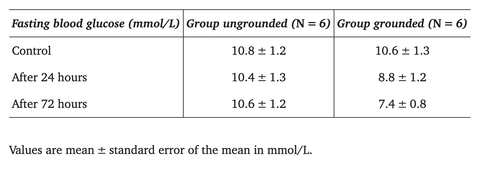
. A single night of grounding during sleep was associated with changes in blood levels of iron, ionised calcium, inorganic phosphorus, and thyroid hormones [14]. Urinary excretion of calcium and phosphorus also decreased significantly, a finding with potential relevance to bone health [14]. In a 72-hour study tracking grounding during both rest and physical activity, fasting glucose levels in diabetic patients decreased, with results that compared favourably to medication and lifestyle management alone [14].
Table: Effect of Earthing the Human Body on Serum Concentration of Glucose
How grounding influences the body
Earthing the Human Body Influences Physiologic Processes
These effects may extend to
cardiovascular health
. Heart rate variability (HRV), a measure of how well the autonomic nervous system regulates cardiovascular function, where a higher reading generally indicates better regulation, improved significantly in healthy participants after 40 minutes of grounding through adhesive electrode patches [15]. Grounding has also been associated with reduced blood viscosity, which is relevant given that thicker blood is commonly observed in people with cardiovascular and metabolic conditions [16]. One study found an average reduction of 14.3% in systolic blood pressure with at least 10 hours of grounding [17]. But when you walk barefoot on grass on a sunny morning, you are not only grounding. You are also getting sunlight, gentle movement, fresh air, and a break from screens. The benefits you feel may come from the combination, not from electrons alone.
How to do it? [18]
Simple ways to ground
The simplest approach is the most direct: take your shoes off.
Grass, soil, sand, rock, stone, and uncoated concrete are all conductive surfaces.
Wooden floors, tiles, carpet, and vinyl are not. Fifteen to thirty minutes is a reasonable starting point, and you can extend from there as it fits your life.
Moisture increases conductivity, so early mornings, when dew is still on the grass, or after light rain are particularly good times. Natural bodies of water work well too: rivers, lakes,
and the
sea
all provide strong grounding contact, as does a
swimming pool
, provided it is not lined with plastic.
There is no reason grounding needs to be a separate activity. Eat lunch outside. Take a call while standing on the grass. Move your morning stretching, breathwork, or yoga session outdoors. Plan a holiday around a natural landscape. The practice integrates easily once you stop thinking of it as a ritual and start thinking of it as a preference.

Grounding products and indoor options
If getting outside regularly is not realistic,
grounding products offer a practical alternative
. These work by connecting conductive materials, typically carbon or metal fibre, to a grounding socket or dedicated earth stake, so the surface maintains the same electrical potential as the ground outside.
Grounding mats
are the most versatile entry point. They can be used as a desk mat, yoga mat, or floor mat, making them easy to incorporate into a work-from-home setup or indoor exercise routine. Saha’nula and Hooga both offer accessible options for those new to grounding.
Grounding sheets, mattresses, and pillowcases allow for extended, passive grounding throughout the night, a practical choice for anyone focused on sleep quality and recovery.
Earthing, Grounding Essentials,
and
BeGrounded
are established names in this category.

Shop grounding tools
For those already comfortable with grounding who want to layer in additional modalities,
HigherDOSE
offers mats that combine grounding with infrared and PEMF (pulsed electromagnetic field) therapy.
On-the-go options include
grounding socks, footwear, and car seat cushions
.
Harmony
and
Baça
have both developed grounded footwear designed for everyday wear.
Safety, sensitivity, and practical tips
Keep in mind
Walking barefoot outdoors does carry a small risk of cuts, punctures, and exposure to parasitic, bacterial, or fungal infections.
Choose your surface with some awareness, a well-kept lawn or clean sandy beach is very different from an urban pavement or unfamiliar woodland floor.
If you are sensitive to metals or prone to allergic reactions, look for products made from stainless steel or stainless steel blended with organic cotton.
These tend to be gentler than alloys containing nickel.
Wild swimming in unfamiliar rivers or open water carries its own risks and is worth researching before you commit.
A pool, provided it is not plastic-lined, offers a similarly grounded experience with considerably less uncertainty.
Common questions
Does walking barefoot on a wooden floor count?
No. Natural conductive surfaces, grass, soil, sand, rock, stone, and uncoated concrete, allow electrons to transfer from the Earth to the body. Wood, tile, carpet, vinyl, and rubber-soled shoes are all insulating materials and do not provide an electrical connection to the ground.
Do you need a grounding mat or mattress to get the benefits?
Not at all. Barefoot contact with the Earth is the most direct and effective form of grounding. Products are a complement to outdoor grounding, not a replacement for it. Their main advantage is practicality: they let you control the duration and fit grounding into your daily routine without needing to go outside every time.